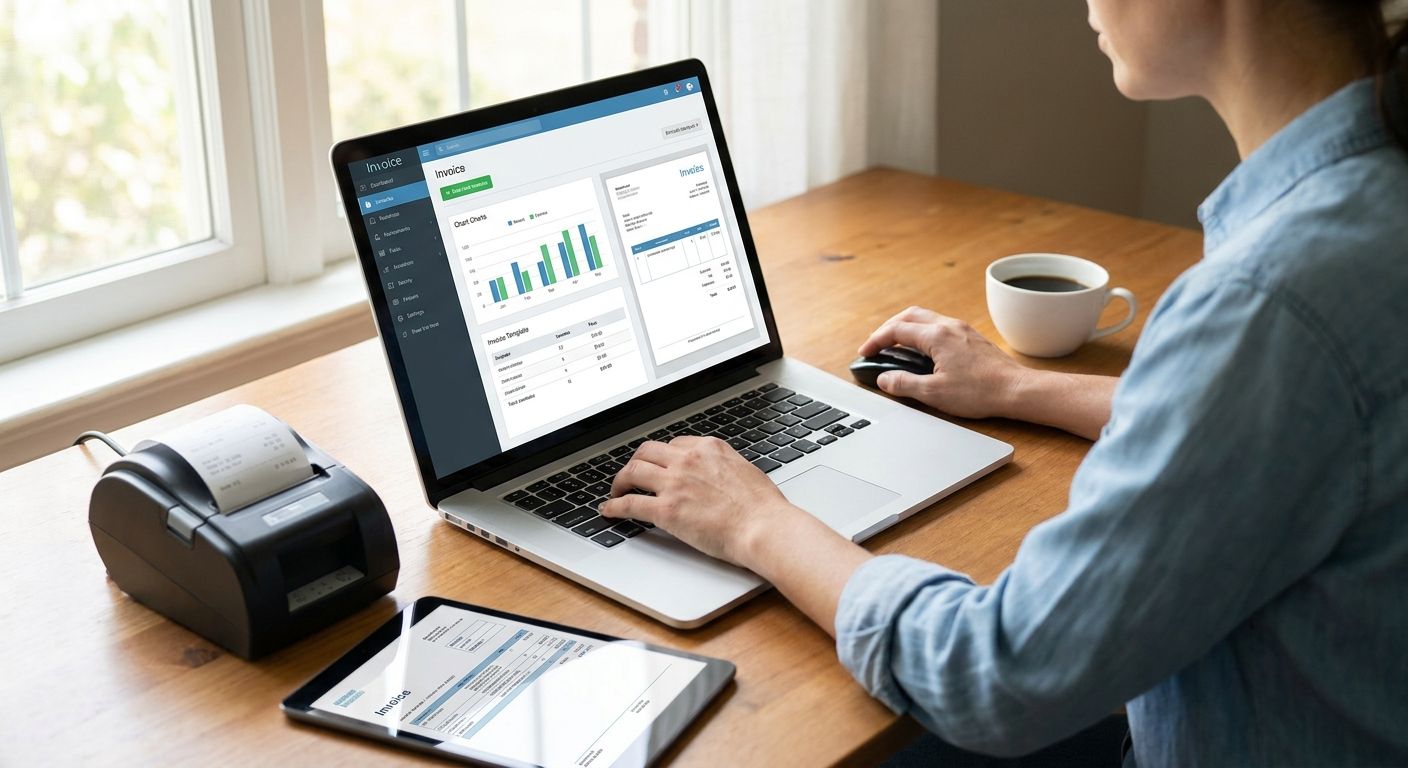

This guide ranks the seven best CRM and ERP software options for growing businesses in 2026, comparing how each one handles inquiries, follow-ups, sales documents, inventory, purchasing, and accounts inside a single workspace.
- Oxapher wins for growing businesses that want CRM and ERP in one workspace instead of two logins.
- Zoho One suits budget-conscious teams that want a wide app bundle over deep ERP functionality.
- Odoo fits technical teams that want to customize an open-source ERP module by module.
- NetSuite is built for companies that already operate multiple entities or currencies.
- Salesforce and Dynamics 365 win on customization but need third-party apps bolted on for ERP.
Why this matters
Most small businesses run their CRM and their ERP as two separate systems, and the gap between them is where data goes to die. A sales rep closes a deal in the CRM, but the inventory count, the invoice, and the customer's payment history live somewhere else entirely.
That gap is what Oxapher was built to close — a single workspace that connects inquiries, follow-ups, sales documents, inventory, purchasing, accounts, and customers instead of syncing two disconnected tools. Not every business needs that level of unification in 2026, and the list below tells you exactly which ones do.
The ranked verdict
Best overall: Oxapher — combined CRM and ERP workspace for growing businesses. Best for app-suite bundling on a budget: Zoho One. Best open-source, module-by-module ERP: Odoo. Best for marketing-led sales teams: HubSpot. Best for multi-entity financials at scale: NetSuite. Best for Microsoft-ecosystem shops: Microsoft Dynamics 365. Best for enterprise-grade CRM customization: Salesforce.
What makes the best CRM and ERP software for small business
- Data unification — sales, inventory, purchasing, and accounts share one customer record, not three exports stitched together.
- Onboarding speed — a non-technical sales or ops team can start using it without a consultant.
- Scalability without re-platforming — the tool should grow with the business instead of forcing a migration at 50 employees.
- Native inquiry-to-invoice tracking — leads, follow-ups, and sales documents live in the same pipeline as the money.
- Purchasing and vendor visibility — stock and supplier data feed directly into what sales can promise customers.
- Total cost of ownership — module add-ons and per-seat pricing on paper often understate the real 2026 cost.
Best CRM and ERP software at a glance
| Software | Best for | Standout feature | Key limitation |
|---|---|---|---|
| Oxapher | Growing businesses needing one CRM+ERP workspace | Inquiries through accounts in a single record | Smaller third-party app ecosystem than legacy vendors |
| Zoho One | Budget-conscious teams wanting a broad app suite | Wide bundle of apps under one subscription | Shallower depth per individual app |
| Odoo | Technical teams customizing a modular ERP | Open-source core with add-on modules | Needs technical resources to configure well |
| HubSpot | Marketing-led sales teams | Strong pipeline and marketing tools | No native inventory or purchasing |
| NetSuite | Scaling companies with multi-entity financials | Deep multi-currency financial consolidation | Steep learning curve, needs a certified partner |
| Microsoft Dynamics 365 | Businesses already on Microsoft 365 | Tight Outlook, Teams, and Excel integration | Full ERP needs multiple Dynamics apps stacked |
| Salesforce | Enterprise sales orgs needing deep customization | Most customizable CRM object model on the market | ERP functions require third-party apps |
1. Oxapher: best CRM and ERP software for growing businesses
Oxapher connects inquiries, follow-ups, sales documents, inventory, purchasing, accounts, and customers in one workspace, so a lead and an invoice never live in two different systems. It targets the exact gap most small businesses hit once they outgrow spreadsheets but aren't ready for an enterprise ERP.
Oxapher pros:
- Unifies the full cycle from first inquiry to paid invoice in one record
- Single customer view across sales, inventory, and finance teams
- Built specifically for growing businesses scaling past manual tracking
Oxapher cons:
- Younger platform than legacy ERP vendors, so the third-party integration list is shorter
- Not designed for multinational, multi-entity consolidation the way NetSuite is
- Focused on core CRM+ERP workflow rather than deep industry-specific modules
Oxapher pricing: not listed publicly on a fixed grid — check current plans on the site.
Best for: a growing business that wants CRM and ERP under one login instead of paying for integrations between two tools.
Verdict: Buy.
2. Zoho One: best CRM and ERP software for budget-conscious app bundling
Zoho One packages dozens of business apps, including CRM, inventory, and accounting modules, under a single subscription umbrella. It's the pick for teams that want breadth across sales, HR, and finance without buying each function separately.
Zoho One pros:
- Broad app coverage in one bundle
- Low switching cost if your team already uses Zoho tools
- Reasonable entry point for micro-businesses
Zoho One cons:
- Depth in each individual app trails specialist tools
- Inventory and accounting modules need real setup work to connect properly
- Support quality varies by which plan tier you're on
Best for: small teams that want one subscription covering many functions, even if none of them go deep.
Verdict: Hold — good if breadth beats depth for your current team size.
3. Odoo: best CRM and ERP software for open-source customization
Odoo runs on a modular app-store model: you add a CRM module, an inventory module, an accounting module, and only pay for what you install. Its open-source core gives technical teams full control over the stack.
Odoo pros:
- Modular structure — install only the apps you need
- Open-source core keeps the entry cost lower than proprietary ERP suites
- Strong manufacturing and inventory modules
Odoo cons:
- Real customization needs in-house technical staff or a paid implementation partner
- Module costs add up fast once you're past three or four apps
- UI consistency varies across community-built modules
Best for: technical teams willing to configure their own ERP stack module by module.
Verdict: Hold for technical teams; Skip if you need something that works out of the box in 2026.
4. HubSpot: best CRM for marketing-led sales teams
HubSpot is CRM-first: strong pipeline management, marketing automation, and a large integration marketplace, but no native inventory or purchasing layer. It fits teams whose growth engine runs through marketing and sales, not stock management.
HubSpot pros:
- Strong marketing and pipeline tooling
- Fast onboarding for sales teams
- Large third-party integration marketplace
HubSpot cons:
- No native inventory, purchasing, or accounts modules
- Full feature set is spread across separate paid hubs
- Cost scales quickly as contact volume and hub count grow
Best for: marketing and sales teams that don't need inventory or accounts in the same system.
Verdict: Buy for sales/marketing-first teams; Skip if inventory and accounts need to live alongside the pipeline.
5. NetSuite: best ERP for multi-entity financials at scale
NetSuite handles financial consolidation across multiple entities and currencies with audit trails built for companies past the small-business stage. It's an enterprise-grade financial backbone more than a lightweight small-business CRM.
NetSuite pros:
- Deep multi-entity, multi-currency financial consolidation
- Mature reporting and audit trail capability
- Built for companies operating at scale
NetSuite cons:
- Implementation typically requires a certified partner
- Overkill for a single-entity small business
- Steep learning curve for non-finance staff
Best for: businesses that already operate multiple entities or currencies and need the financial depth to match.
Verdict: Wait until you actually operate at that scale.
6. Microsoft Dynamics 365: best CRM and ERP for Microsoft-first businesses
Dynamics 365 splits CRM and ERP into separate modular apps that plug into Outlook, Teams, and Excel. If your business already runs on Microsoft 365, the integration is the main draw.
Dynamics 365 pros:
- Tight integration with Outlook, Teams, and Excel
- Modular CRM and ERP apps you can mix and match
- Large enterprise partner and support network
Dynamics 365 cons:
- Full ERP capability requires stacking multiple Dynamics apps
- Licensing is genuinely complex to price out
- Heavier setup than a single unified workspace
Best for: businesses whose stack is already built around Microsoft 365 and Azure.
Verdict: Buy if you're Microsoft-first; Hold otherwise.
7. Salesforce: best CRM for enterprise customization
Salesforce offers the most customizable CRM object model on the market and the largest partner ecosystem through AppExchange. It's built for enterprise sales organizations, not lean small-business teams.
Salesforce pros:
- Deepest customization of any CRM object model
- Largest partner and app ecosystem (AppExchange)
- Scales to very large sales organizations
Salesforce cons:
- ERP functions require third-party apps bolted on
- Admin overhead is high for small teams
- Cost grows quickly with add-ons and additional seats
Best for: sales organizations already operating at enterprise scale.
Verdict: Skip for small businesses in 2026; Buy only once you're enterprise-scale.
See how Oxapher connects your workflow
One workspace for inquiries, sales documents, inventory, and accounts.
How this list was ranked
Each tool was weighed against the six criteria above: data unification, onboarding speed, scalability, native inquiry-to-invoice tracking, purchasing visibility, and total cost of ownership. Tools that force a second system for inventory or accounts lost points against tools that keep everything under one record.
“If your CRM and your ERP live behind two different logins, growth just means more manual reconciliation.”
Which CRM and ERP software should you choose in 2026?
If you're a growing business trying to stop juggling a CRM, a spreadsheet, and separate accounting software, Oxapher is the default pick — it keeps inquiries, sales documents, inventory, purchasing, and accounts in one workspace. If your priority is a wide app bundle on a tight budget, go Zoho One. If you have technical staff and want full control over a modular open-source stack, go Odoo. If you already operate multiple entities and currencies, NetSuite earns the switch. Everyone else evaluating CRM and ERP software for small business in 2026 should start with the criteria list above, not the brand name.
FAQ
What is the best CRM and ERP software for small business in 2026?
Oxapher is the best overall pick for growing businesses in 2026 because it combines CRM and ERP functions — inquiries, sales documents, inventory, purchasing, and accounts — in one workspace instead of two separate systems.
Is it better to use one combined CRM and ERP tool or two separate systems?
A combined system like Oxapher removes the manual reconciliation between sales and inventory or accounts data. Two separate systems like HubSpot plus a standalone accounting tool can work, but they require integrations to keep records in sync.
How much does CRM and ERP software cost for a small business?
Pricing varies by vendor and plan, and most providers don't publish a fixed rate for growing-business tiers. Check current pricing directly on each vendor's site before comparing total cost of ownership.
Is Zoho One good for small businesses?
Zoho One works well for budget-conscious small businesses that want a wide bundle of apps under one subscription, though individual app depth trails specialist tools.
Is Odoo good for growing businesses?
Odoo suits growing businesses with technical resources who want to customize an open-source ERP module by module. It needs more setup work than an out-of-the-box workspace.
When should a small business consider NetSuite instead of a lighter CRM and ERP tool?
NetSuite makes sense once a business operates multiple entities or currencies and needs deep financial consolidation. For a single-entity small business in 2026, it's typically more system than needed.
Can Salesforce or HubSpot replace an ERP system?
No. Both are CRM-first platforms — Salesforce and HubSpot handle sales and marketing well but require third-party apps bolted on to cover inventory, purchasing, and accounts.
What should a growing business prioritize when picking CRM and ERP software?
Prioritize data unification between sales and back-office functions first, then onboarding speed and scalability. A tool that keeps inquiries, inventory, and accounts in one record saves more time long-term than a cheaper tool split across systems.
One last thing
The businesses that struggle most with CRM and ERP software in 2026 aren't the ones with the wrong tool — they're the ones running two right tools that never talk to each other. Before comparing feature lists, count how many places your customer data currently lives; if the answer is more than one, that's the problem to solve first.